Protection · Surface Engineering

Corrosion Mitigation

Sour gas, hydrogen, salt, and heat destroy conventional metal. Green Horizon engineers two complementary defenses — an impervious ceramic gradient coating and a 3D laser-clad WC-N alloy lattice — that stop corrosion, hydrogen embrittlement, and extreme-environment wear at the source.

Impervious ceramic gradient corrosion barrier
System One

Impervious ceramic gradient coating

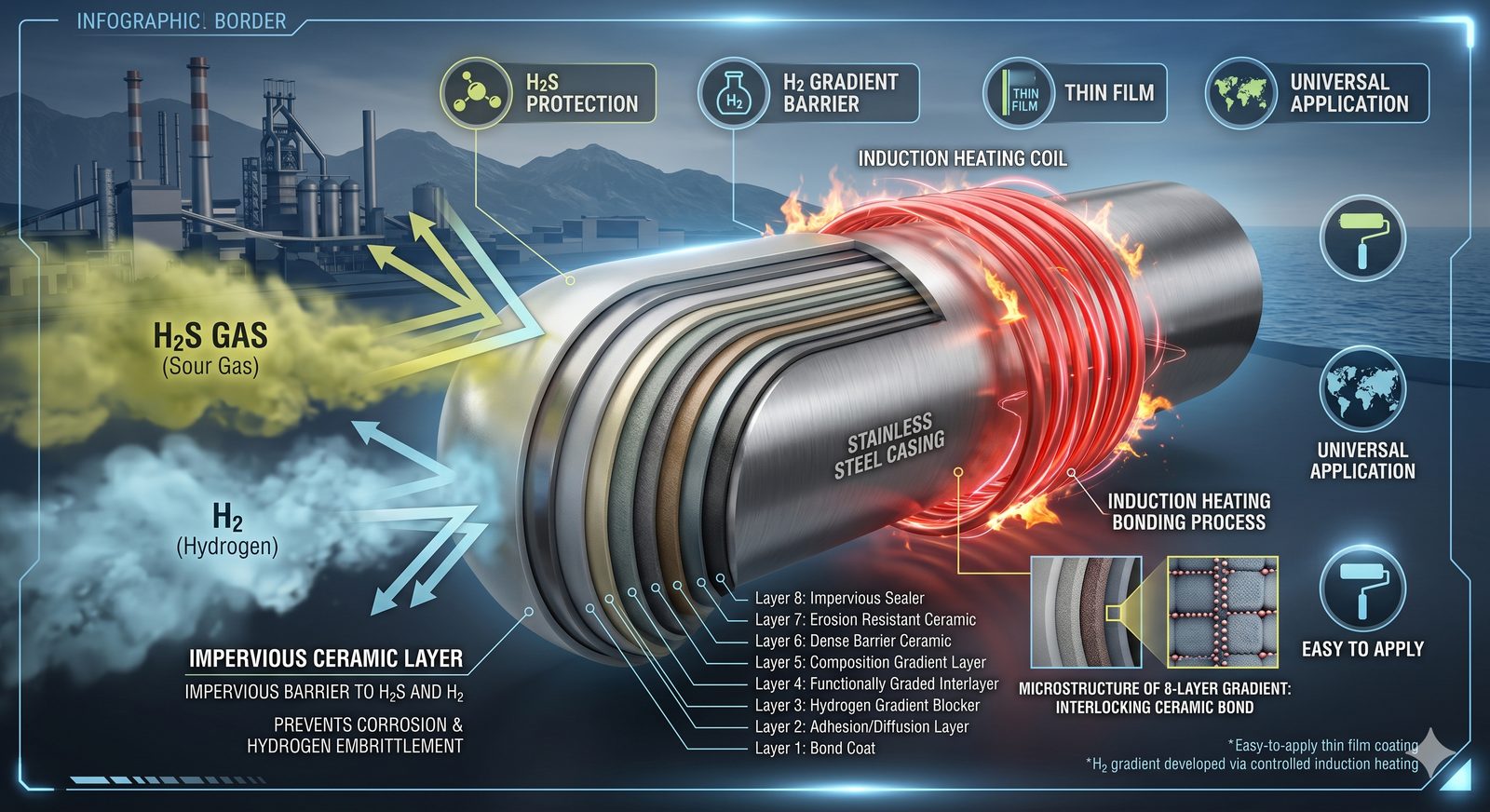
An easy-to-apply thin-film ceramic that forms an impervious barrier to H₂S and hydrogen, preventing corrosion and hydrogen embrittlement. The hydrogen gradient is developed through controlled induction-heating bonding, producing an interlocking ceramic bond across a functionally graded microstructure.

  • H₂S (sour gas) protection
  • Hydrogen gradient barrier — blocks embrittlement
  • Thin-film, universal application
  • Induction-heating bonding for an interlocking ceramic bond
Gradient Architecture

A functionally graded ceramic stack.

Nine engineered layers transition from the metal substrate to a fully impervious sealed surface, each tuned to its role in the barrier.

LayerFunction
1 — Bond coatAdheres the system to the metal substrate
2 — Diffusion layerLocks the coating into the substrate surface
3 — Adhesion layerMechanical and chemical anchoring
4 — Hydrogen gradient blockerArrests hydrogen migration into the metal
5 — Functionally graded interlayerSmooths stress and thermal-expansion mismatch
6 — Composition gradient ceramicTransitions composition toward dense ceramic
7 — Dense ceramicPrimary impermeable barrier body
8 — Erosion-resistant ceramicResists abrasive and flow-driven wear
9 — Impervious sealerFinal seal against H₂S and H₂ ingress
3D laser-clad WC-N alloy lattice
System Two

3D laser-clad WC-N alloy lattice

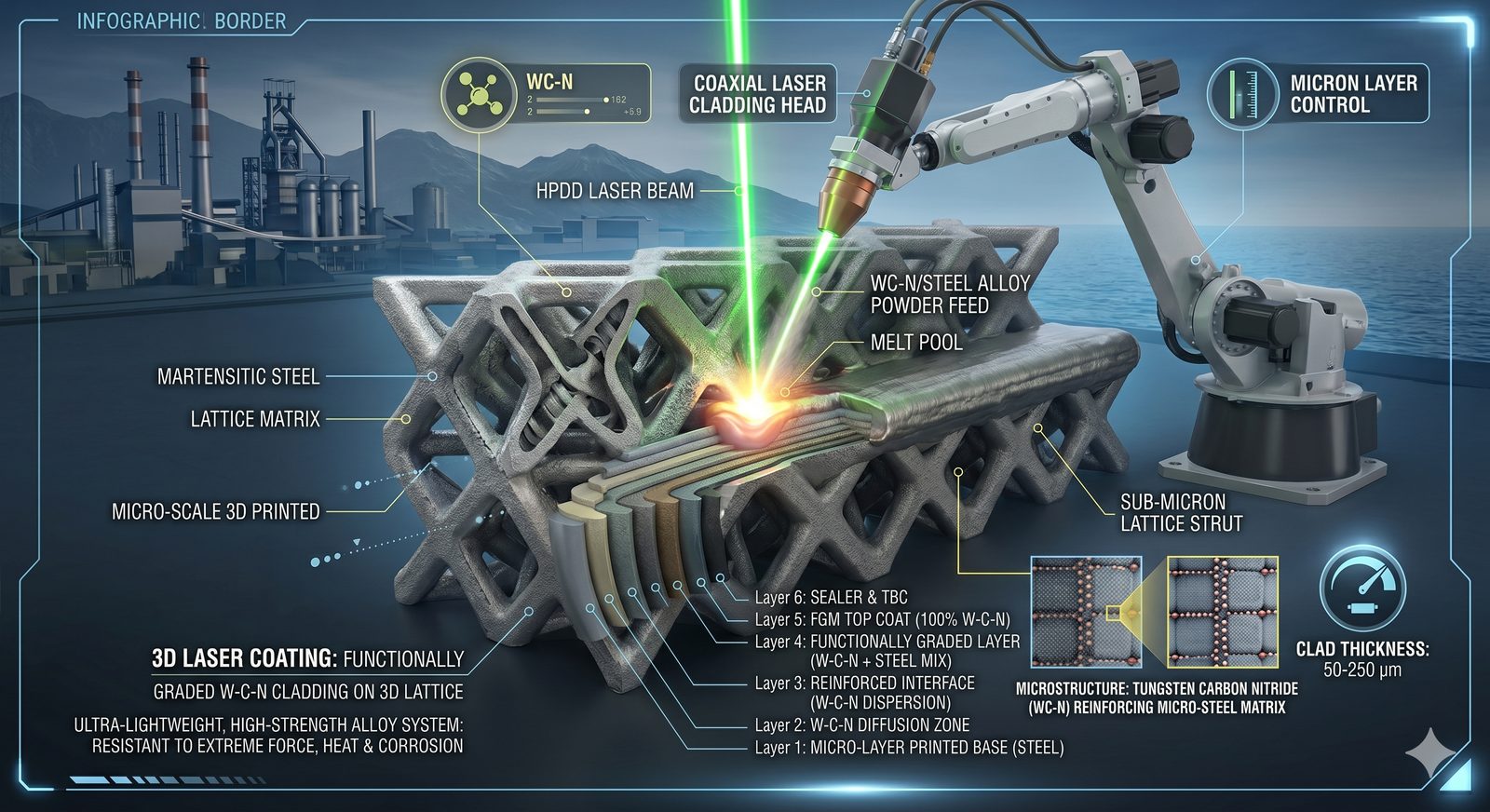
An ultra-lightweight, high-strength alloy system: functionally graded tungsten-carbon-nitride (WC-N) cladding laser-deposited onto a micro-scale 3D-printed steel lattice. A high-power direct-diode (HPDD) laser and coaxial cladding head build the coating with micron-level layer control — producing a WC-N reinforced micro-steel matrix resistant to extreme force, heat, and corrosion.

  • Functionally graded W-C-N cladding on a 3D lattice
  • Clad thickness 50–250 µm with micron layer control
  • Martensitic-steel lattice matrix, micro-scale 3D printed
  • Resistant to extreme force, heat, and corrosion
Clad Build-Up

From printed steel to 100% WC-N surface.

1

Micro-scale 3D-printed base

Martensitic steel lattice — the lightweight structural matrix.

2

W-C-N diffusion zone

Metallurgical bonding of the cladding into the steel.

3

Reinforced interface

WC-N in dispersion, anchoring the graded layers.

4

Functionally graded layer

W-C-N / steel mix transitioning toward the hard surface.

5

FGM top coat

100% W-C-N — the wear and corrosion face.

6

Sealer & TBC

Thermal-barrier sealing coat for high-heat service.

H₂S + H₂
Dual barrier — corrosion & embrittlement
50–250 µm
Laser-clad thickness range
9-layer
Functionally graded ceramic stack
Universal
Thin-film application surface

Stop corrosion before it starts.

Request the corrosion-mitigation technical package or discuss a coating program for your assets.